Reversus: A Physics Investigation
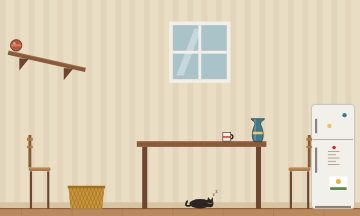
A physics puzzle that runs backwards. Something has already happened — a vase lies broken on the floor, the ball is in the basket, the cat has bolted. All you have is a photo of the aftermath. Your job is to work out what happened: rebuild the hidden mechanism that led to exactly this scene.
How it plays
Every case starts with the photo and a case file: where and when it happened, what is fragile, and which parts you have — ramps, trampolines, catapults, fans, conveyor belts, pendulums, pulleys, cushions and stoppers. You place the parts on a blueprint of the room as it was before, press Run, and watch the physics play out. The game then compares the ending with the photo, piece of evidence by piece of evidence, and tells you how close you are. At 90% the case is solved; fewer parts and higher accuracy earn more stars.
The physics is real and deterministic: weight, bounces, friction and slopes behave the same way every time, so every small change you make is a clue. There is no timer and no limit on attempts — it is a detective game, not a reflex test.
Thirty places, each with its own physics
The game is divided into chapters, and every chapter is a place with ten cases. The kitchen and the office teach the game one part at a time; after that the rooms get stranger:
- A train compartment that speeds up and brakes, and a plane cabin that drops into air pockets.
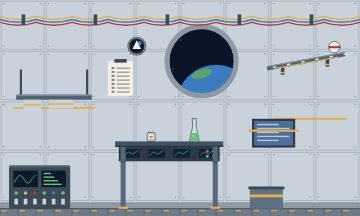
- A space station in zero gravity, where the ball flies in a straight line until it hits something.
- A Moon base and a Mars base, where everything falls slower and flies further.
- A ship's cabin rolling on the waves, a freight lift going up and down, a carousel pavilion that spins.
- An ice rink where nothing stops, a swimming pool, a chemistry lab with a magnet, a theatre stage with a trapdoor.
- And ordinary places with their own furniture and objects: a garage, a café, a library, a pet shop, a hospital ward, a greenhouse, a museum hall…
Each player gets their own cases in every place, made by the game's case generator and checked to be solvable, so two friends can compare notes without spoiling each other's answers.
Kinds of cases
- Ordinary cases — a photo, the evidence, and a mechanism to find.
- “What went wrong” — the mechanism is already on the blueprint, but one part is off. Find it and fix it.
- “Prevent it” — add a part so that the vase survives.
- “Two targets” — two things in different corners of the room were hit; one throw will not do it.
- Chapter finals — several hidden parts, a chain of events and photos taken along the way.
Some cases bring extra evidence: a security camera that caught the ball crossing part of the room, marks where the ball hit the walls, a witness who heard which thing broke first.
Daily case, level builder, catalog
A new daily case appears every day, the same for everyone, with a ranking by attempts and parts used. In the level builder you can arrange any room yourself — the ball, the furniture, the cat — hide a mechanism and share the level as a link, or publish it to the catalog, where players like, solve and report levels.
Free, in the browser, in 15 languages
Reversus is free to play in any modern browser, on a computer or a phone, with nothing to install. Progress is kept in the browser; signing in with Google is optional and only carries your progress to your other devices. The game is available in English, Ukrainian, Russian, Georgian, German, French, Spanish, Portuguese, Italian, Polish, Turkish, Chinese (simplified and traditional), Japanese and Korean.
Music and sound effects are by other authors under the CC0 licence; the credits are in the game's sound settings.
Contact
Questions, ideas or a level that does not work: [email protected].